Fujifilm Instax Mini 13 Review: Proof that instant cameras are still fun
Fujifilm’s budget Instax Mini line has always been more about fun than technical prowess, and the Mini 13 sticks firmly to that formula. It doesn’t reinvent what came before with the Mini 12, but it refines it in small, meaningful ways.
Here’s everything you need to know before picking one up.
Design
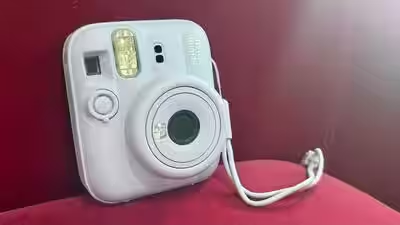
The Instax Mini 13 goes for a soft, rounded, “pillowy” aesthetic that immediately signals it isn’t aimed at serious photographers — this is a camera built for parties, travel snapshots, and casual selfies, and its design leans fully into that identity. It comes in five colours — Dreamy Purple, Frost Blue, Candy Pink, Lagoon Green, and Clay White — each finished with a metallic Instax logo that adds a touch of polish to an otherwise playful shell.
Despite the bulk that comes with housing instant film, it’s genuinely easy to hold, weighing just around 306 grams.
Fujifilm has kept the control layout largely familiar to anyone who’s used the Mini 12, but with a few worthwhile tweaks. On the front, you’ll find the lens barrel and lens ring (twisted to power the camera on), the shutter button sitting front and centre, a built-in selfie mirror just beside the lens for easy self-portraits, and the flash positioned above the lens barrel — which, notably, cannot be switched off and fires with every single shot, regardless of lighting conditions.
The standout new addition is a mechanical self-timer collar wrapped around the base of the shutter button: a quick flick sets a 2-second timer (ideal for reducing handheld blur on selfies), while twisting and holding it for two seconds locks in a 10-second countdown for group shots, with an orange LED clearly signalling which mode is active. On the rear, you’ll find the viewfinder, film door with its confirmation window and counter, and the film door lock.
The bottom of the camera is completely flat with no tripod mount, so the 10-second group timer can’t be paired with a tripod — worth knowing if you were hoping to set up hands-free group shots.
Performance
Getting the Mini 13 up and running takes only a couple of minutes. Start by popping open the battery cover on the side and inserting two AA batteries — no charging cables or proprietary batteries to worry about here. Next, open the film door on the back and load a pack of Fujifilm Instax Mini instant film (sold separately), making sure it clicks into place before closing the door; the film counter on the back will confirm how many shots you have remaining in the pack.
Once loaded, simply rotate the lens barrel to twist the camera into its “on” position — this alone activates the camera and extends the lens, and you’re ready to shoot. There’s no menu to dig through and no manual settings to configure, since the Mini 13 handles exposure and flash entirely automatically, picking a shutter speed between 1/2 and 1/250 of a second based on the light in the scene. To take a photo, just look through the small 0.37x viewfinder, frame your shot, and press the shutter button.
If you’re shooting up close, twist the lens ring into Close-Up mode, which activates parallax correction to keep close subjects properly framed. After each shot, the photo physically ejects from the front slot and develops in front of you over roughly 90 seconds — no app, no printer, and no waiting beyond that.
Features & Image Quality
Despite its toy-like appearance, the Mini 13 packs in a handful of genuinely useful features for its price.
Beyond the mechanical self-timer and selfie mirror, it includes automatic exposure and flash control tuned for both bright daylight and dim indoor settings, along with the aforementioned Close-Up mode for tighter framing. It uses the same 60mm f/12.7 lens found across most Instax Mini cameras, paired with Instax Mini film rated at a notably sensitive ISO 800, which helps it cope reasonably well in lower light.
Image quality is where expectations need to stay realistic — this was never meant to compete with a proper camera, and Fujifilm doesn’t pretend otherwise.
Most shots come out with a charming, retro colour cast that’s become something of a signature Instax look, and results are generally pleasing, particularly indoors or in dimly lit settings like bars and evening parties, where the always-on flash does a lot of heavy lifting. In very bright, sunlit conditions, photos can occasionally come out slightly overexposed, since there’s no way to dial back or disable the flash.
Because the flash fires unconditionally on every shot, the Mini 13 essentially has one consistent photographic “look” across most conditions — which some will find part of its charm, and others may find limiting.
Verdict
Priced at Rs 8,499, the Fujifilm Instax Mini 13 doesn’t try to be anything more than what it is: an affordable, colourful, beginner-friendly instant camera built for spontaneous memories rather than technical precision.
The new self-timer collar and slightly more rounded, comfortable design are welcome, if modest, upgrades over the Mini 12, and the fully automatic shooting experience makes it about as easy to use as an instant camera gets. If you already own the Mini 12, there’s little reason to rush into an upgrade. But if you’re buying an instant camera for the first time — for parties, travel, or simply the joy of a physical print in your hand — the Instax Mini 13 remains an easy, charming recommendation.